9 Best WiFi Meat Thermometers for Grilling (November 2026)
The best WiFi meat thermometers for grilling include the Govee WiFi Meat Thermometer Digital for Grilling for most backyard cooks, the CHEF iQ Sense 2-Probe for high-heat searing, and the Nutrichef Wireless Meat Thermometer with 2 Stainless for simple presets.
On this page (9 sections)
- The best WiFi meat thermometers for grilling
- How these WiFi grill thermometers compare
- How we compared these WiFi meat thermometers
- Do you need WiFi on a grill thermometer, or is Bluetooth enough?
- How many probes does a grilling cook need?
- What heat limits should you check before buying?
- Which app features actually help during a cook?
- WiFi grill thermometer buying checklist
- Best WiFi meat thermometer for grilling: the verdict
The best WiFi meat thermometer for grilling for most people is the Govee WiFi Meat Thermometer Digital for Grilling, because two probes rated to 572°F cover low-and-slow smoking and high-heat searing, and the 24-hour log lets you repeat a cook that worked. Go with the CHEF iQ Sense 2-Probe if you sear at very high heat, or the ThermoMaven G2 if your grill sits far from the house.
WiFi changes the job a thermometer does. A Bluetooth unit keeps you near the patio; a WiFi unit puts the readout on your phone wherever you are.
That matters when the brisket runs past midnight or you want to sit inside while the coals settle.
Every pick here sends alerts to a phone, but they differ in probe count, heat limits, battery life and whether the base works without the app. Read the rest of this guide to match those differences to how you actually grill.
Our picks at a glance
-
1
 Best for most backyard cooks
Govee WiFi Meat Thermometer Digital for Grilling
9.7/10 our score
See it on Amazon -
2

-
3
 Best for simple presets
Nutrichef Wireless Meat Thermometer with 2 Stainless
8.7/10 our score
See it on Amazon
The best WiFi meat thermometers for grilling
Govee's two-probe unit is the best all-around pick for most backyard cooks. The rest of the list fills narrower needs: high-heat searing, cooking four cuts at once, long signal reach, or a screen that works without a phone.
Govee WiFi Meat Thermometer Digital for Grilling: Best for most backyard cooks
- Two heat-resistant probes, 32 to 572°F
- 24-hour temperature tracking with export
- Batteries last up to 120 four-hour sessions
- AI cooking time estimates
A two-probe WiFi thermometer with a long battery life and a temperature history you can save. It covers smoking and searing without a cable running into the house.
Pros
- 24-hour tracking you can export
- Battery rated for about 120 cooks
- Two probes for separate cuts or zones
Cons
- Remote monitoring runs through the app
- Probes should not sit in open flame or water
Govee's two-probe model is the pick for a normal backyard setup. Both probes handle 32 to 572°F, so one can sit in a pork shoulder while the other watches a chicken breast or the grill's own air temperature.
The app sends an alert when meat reaches your target and estimates the remaining cook time, which helps plan sides. A 24-hour temperature log records the whole session, and you can export the curve to repeat a cook that turned out well.
Battery life is the standout: Govee rates one set of AA batteries for up to 120 four-hour sessions. That covers a full grilling season without a recharge, so this is the unit to leave in the cabinet and grab on a whim.
The trade-off is that remote monitoring runs through the app, so there is no standalone screen to set a target on the base. For cooks who want to leave the phone indoors and just glance at a display, the ThermoMaven P2 or G2 fits better.
Everyone else gets the most complete feature set at the lowest complexity.
CHEF iQ Sense 2-Probe: Best for high-heat searing
- Probes rated to 1000°F
- Five sensors, four internal plus ambient
- Up to 50 hours per charge
- Dishwasher-safe probes
Ultra-thin probes that tolerate very high heat, backed by a hub with a speaker and a big recipe library. Suits cooks who sear hard and want the probe to stay in place.
Pros
- 1000°F probe rating
- Four internal sensors plus ambient
- Dishwasher-safe probes
Cons
- Costs more than the Govee
- Hub needs charging between long cooks
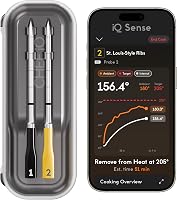
The CHEF iQ Sense is the pick when your grill runs hot. Its probes are rated to 1000°F, well above the 572°F limit on most models here, so you can leave them in during a hard sear or a pizza run without worrying about the tip.
Each set carries five sensors: four internal readings plus an ambient sensor for the cooking chamber. That combination gives you meat temperature and grill temperature at once from one probe, which helps when the lid stays closed for a long stretch.
The hub holds a charge for up to 50 hours and includes a speaker for audio alerts as well as phone notifications. Probes are dishwasher-safe and the kit includes two.
The trade-off is cost. This sits a tier above the Govee two-probe, and you pay for the heat tolerance and sensor count.
If your cooking stays under 500°F, the extra headroom rarely gets used.
Buy it if you sear hard or cook over an open flame and want the probe to stay put.
Nutrichef Wireless Meat Thermometer with 2 Stainless: Best for simple presets
- 10 meat and 5 doneness presets
- Two probes plus an ambient probe
- 2.4 GHz WiFi and Bluetooth
- LCD display on the unit
A preset-heavy thermometer with its own screen, so you can set a target without opening the app. Good for cooks who want guidance more than raw data.
Pros
- Presets for 10 meats and 5 doneness levels
- Built-in LCD display
- Probe cable rated to 716°F
Cons
- Two probes only
- Presets are less flexible than custom targets
Nutrichef's unit suits cooks who want the app to tell them what to do. It ships with 10 meat presets and 5 doneness settings, so you can pick "pork loin, medium" and let the thermometer track the target instead of typing a number.
Two probes plus an ambient probe are in the box. The probes handle up to 572°F and the probe cable is rated to 716°F, so you can route it through the grill lid without the wire being the weak point.
An LCD on the unit means you can read temps without opening your phone. The 2000mAh rechargeable battery covers a long afternoon, and the app keeps a temperature history you can export.
The trade-off is flexibility. Presets are quick, but custom targets and multi-zone cooks take more tapping than on the Govee or ThermoMaven apps.
Pick it if you like guided settings and want a screen on the base.
Skip it if you plan to run four probes or chase very precise numbers.
ThermoMaven WiFi 2-Probe: Best for app-free control

- Smart display base sets targets without the app
- Six sensors, five internal plus one ambient
- NIST-certified accuracy at ±0.5°F
- Probes rated to 752°F ambient
A WiFi thermometer whose base works on its own, so you can set a target and read temps without a phone. The certified accuracy suits cooks who want tight numbers.
Pros
- Works without the app
- NIST-certified ±0.5°F accuracy
- Dishwasher-safe probes
Cons
- Probes are wireless and need charging
- Two probes only
The ThermoMaven P2 is the pick for anyone who does not want a phone in the middle of a cook. Its display base sets target temperatures and shows live readings on its own, so you can walk out, set a number and go back inside.
The probes carry six sensors, five internal plus one ambient, and ThermoMaven quotes NIST-certified accuracy of ±0.5°F. That is tighter than the 1.8°F most units here quote, and it matters when you are cooking something like a pork loin where a few degrees changes the result.
Probes handle 221°F internally and 752°F ambient, so they can sit in the grill through a hot cook. They are IPX8 waterproof and dishwasher-safe.
The base charges in about 2 hours for 24-plus hours of use, and probes get 2 hours of work from a 2-minute charge.
The trade-off is that the WiFi link runs from the base, not the probes, and the base needs a 2.4 GHz network. Two probes is also fewer than the four-probe units here.
Buy it for certified accuracy and app-free control.
InkGrill Wireless Meat Thermometer with APP Control,4: Best for cooking four things at once

- Four probes with two sensors each
- Bluetooth, WiFi and local modes
- 28 USDA presets in the app
- 30 minutes of offline data storage
Four probes make it easy to run steaks, chicken, pork and fish together. The base keeps logging for 30 minutes if the signal drops.
Pros
- Four probes for separate cuts
- Offline data storage on the base
- Magnetic base with a bright screen
Cons
- All four probes must stay charged during the cook
- App is needed for presets and alerts
InkGrill's four-probe unit is the pick for a cook who runs several cuts at once. Steak, chicken, pork and fish can each have a probe, and the app shows all four with independent targets.
Each probe has two sensors, one for internal meat temperature from 14 to 212°F and one for the ambient air up to 572°F. That means each probe can tell you both how the meat is doing and how hot the grill is running.
Connectivity offers three modes: Bluetooth for the backyard, WiFi for monitoring from the office, and a local mode for weak signals. If the link drops, the base stores 30 minutes of data and syncs when the connection returns.
The base has a magnetic back and a bright screen that stays readable in sun. A 25-minute charge covers a full day, and the probes are IP67 waterproof and dishwasher-safe.
The trade-off is that all four probes must stay charged during the cook, and the app is needed for presets and alerts.
Pick it for volume, not simplicity.
ThermoMaven Sub-1G 2-Probe: Best for long signal reach

- Sub-1G radio rated for 3000 ft unobstructed
- Two wireless probes rated to 752°F ambient
- NIST-certified ±0.5°F accuracy
- Dishwasher-safe probes
Built for big properties and long walks away from the grill. The radio link reaches much farther than WiFi alone, and the display base still works without a phone.
Pros
- Very long range
- Works without the app
- High-heat ambient rating
Cons
- Two probes only
- The phone app reaches the base over your home network, not the radio link
The ThermoMaven G2 is the pick when the grill is far from the house. It uses Sub-1G radio to reach up to 3000 ft unobstructed, or about 700 ft with walls and trees in the way.
That beats WiFi in open country and beats Bluetooth by a wide margin.
Like the P2, the G2 has a display base that works without a phone. You can set a target and read temps directly on the unit.
The app adds cooking history and guided modes when you want them.
Each probe carries six NIST-certified sensors with ±0.5°F accuracy. Probes handle 221°F internal and 752°F ambient, are IPX8 waterproof and go in the dishwasher.
The base runs 24-plus hours on a 2-hour charge, and probes get 2 hours from a 2-minute top-up.
The trade-off is that Sub-1G is not WiFi, so the phone app reaches the base over your home network, not over the radio link. That is fine at home and less useful when you are away.
Pick it for range, especially on acreage or in a campground.
INKBIRD IBBQ-4T: Best for budget four-probe cooks

- Four colored probes
- 2.4 GHz WiFi
- 2000mAh battery rated for about 26 hours
- Temperature graph export in the app
A four-probe WiFi thermometer with colored probes and a magnetic body. The lower continuous heat limit means it suits low-and-slow cooking more than hard searing.
Pros
- Four probes on a budget
- Magnet sticks to the grill or oven
- Graph export in the app
Cons
- 482°F continuous limit
- Body should stay under 176°F
The INKBIRD IBBQ-4T is the budget route to four probes and WiFi. Four colored probes help you keep track of which cut is which, and the magnetic body sticks to the grill, oven or fridge.
Its 2.4 GHz WiFi link works with the Inkbird Pro app, and more than one phone can control the same unit. A 2000mAh battery runs about 26 hours per charge.
The app offers temperature graphs you can download and a calibration feature to keep accuracy in check after long use.
The heat limits are the catch. The short-time measurement range reaches 572°F, but the continuous monitoring range tops out at 482°F.
Inkbird also warns the plastic body should not exceed 176°F, so keep the unit off the hot side of the grill.
The trade-off is heat tolerance against the price. It suits low-and-slow cooks who want four probes without spending much.
For searing or a hot pizza cook, the CHEF iQ Sense or either ThermoMaven is the safer choice.
INKBIRD WiFi 4-Probe: Best for mixed connectivity

- WiFi, Bluetooth and non-phone modes
- Four probes with two sensors each
- 28 USDA presets in the app
- IP67 waterproof probes
A four-probe thermometer that runs over WiFi at home, Bluetooth at a campsite or without a phone at all. The screen sits on the charging stand.
Pros
- Works without a phone
- Four probes
- Dishwasher-safe probes
Cons
- Body should stay under 176°F
- Base is heavier than most here
The INKBIRD WiFi 4-Probe offers the widest set of connection options here. It runs over 2.4 GHz WiFi with unlimited range, over Bluetooth at about 300 ft, or in a non-phone mode for people who do not want an app at all.
That last mode suits older cooks or anyone who wants the base to stand alone.
Four probes each carry two sensors, one at the tip for meat and one for ambient air. Food temperature runs 14 to 212°F and ambient runs 32 to 572°F.
Accuracy is ±1.8°F with a calibration feature to correct drift.
The 2.24-inch backlit screen on the charging stand shows all four probes at once. The unit stores 30 minutes of data without a phone.
A 25-hour charge and IP67 probes round it out.
The trade-off is bulk and heat handling. The base is heavier than most here, and like the IBBQ-4T the plastic body should stay under 176°F.
Pick it for mixed use, home and campsite, more than for a single hot sear.
Govee WiFi 4-Probe: Best for all-day smoker sessions

- Four probes
- 3000mAh battery rated for 40 hours
- 28 USDA presets
- WiFi and Bluetooth
A long battery life paired with four probes. A solid choice for overnight brisket where charging mid-cook is not an option.
Pros
- 40 hours per charge
- Four probes
- Presets for 28 cuts
Cons
- Probes should not sit in open flame or water
- Older design than the Govee two-probe
Govee's four-probe model is the pick for overnight cooks. Its 3000mAh rechargeable battery is rated for up to 40 hours on a charge, so a brisket that runs 14 hours does not need a mid-cook top-up.
Four food-grade probes handle 32 to 572°F with ±1.8°F accuracy. The app offers 28 USDA presets across beef, lamb, chicken, pork and turkey, plus alerts on the base and the phone when a temperature leaves your preset range.
WiFi and Bluetooth are both built in. The probes are IPX7 waterproof, and the 40-inch cables give you room to route through a lid or around a rotisserie.
The trade-off is age and care. This is an older design than the Govee two-probe above, and Govee warns against exposing the probes to open flame or soaking them in water.
Buy it for all-day and overnight sessions where battery life matters more than the newest app features.
How these WiFi grill thermometers compare
A comparison table puts the connectivity, probe count and heat limits side by side so you can narrow the field before reading the full write-ups. Check the current figure on the product page rather than trusting an older number.
| Product | Best for | Connectivity | Probe range | Accuracy | Our score |
|---|---|---|---|---|---|
| Govee WiFi Meat Thermometer Digital for Grilling | most backyard cooks | WiFi via Govee Home app | 32 to 572°F | 1.8°F/1°C | 9.7 |
| CHEF iQ Sense 2-Probe | high-heat searing | Bluetooth and WiFi | 8.8 | ||
| Nutrichef Wireless Meat Thermometer with 2 Stainless | simple presets | Bluetooth and WiFi | 8.7 | ||
| ThermoMaven WiFi 2-Probe | app-free control | Bluetooth and 2.4 GHz WiFi | ±0.5°F | 8.6 | |
| InkGrill Wireless Meat Thermometer with APP Control,4 | cooking four things at once | Bluetooth and WiFi | 14 to 572°F | 8.5 | |
| ThermoMaven Sub-1G 2-Probe | long signal reach | Sub-1G and WiFi | 8.1 | ||
| INKBIRD IBBQ-4T | budget four-probe cooks | 2.4 GHz WiFi | 7.7 | ||
| INKBIRD WiFi 4-Probe | mixed connectivity | WiFi | 14 to 572°F | 7.6 | |
| Govee WiFi 4-Probe | all-day smoker sessions | WiFi and Bluetooth | 32 to 572°F | 7.4 |
How we compared these WiFi meat thermometers
We compared the specs each brand publishes and matched them to what a grilling cook actually needs. That means connectivity type and range, probe count, probe and cable heat limits, quoted accuracy, battery life and what the app does.
WiFi versus Bluetooth mattered most. A WiFi thermometer only earns its name if the base talks to your home network and pushes alerts to a phone away from the patio.
Units that use WiFi only as a bridge for setup scored lower here.
Heat limits decided several placements. Probes rated to 572°F handle most smoking and roasting, but a 1000°F probe like the CHEF iQ Sense's is the safer pick for searing and open flame.
Ambient ratings matter too, since a probe sitting in a hot grill sees more than the meat does.
We also weighed whether the base works without a phone. A standalone display is a real advantage for people who do not want an app open during dinner.
Our score weighs specs, features and buyer feedback against what you're shopping for. Every heat limit and battery figure above comes from the brand.
Do you need WiFi on a grill thermometer, or is Bluetooth enough?
WiFi is worth it if your grill sits more than a room away from where you spend the cook. Bluetooth covers a backyard within about 300 ft, while WiFi reaches through your home network wherever your phone has a signal.
Think about your actual routine. If you stand at the grill the whole time, a Bluetooth thermometer does the job and costs less.
If you check temps from the couch, the office or an RV, WiFi is the feature you will notice every cook.
Range claims also mix two different distances. WiFi range depends on your router and walls, while Sub-1G radio like the ThermoMaven G2's reaches far in open country.
Our guide to whether wireless meat thermometers need WiFi walks through when the extra radio is worth paying for.
When WiFi earns its keep
Pick WiFi if you monitor from indoors, leave the house during a long cook, or grill on a patio far from the kitchen. The Govee two-probe and the CHEF iQ Sense both push alerts to a phone anywhere on your network.
When Bluetooth is the better call
Pick Bluetooth if you stay near the grill and want the simplest setup. The CHEF iQ Sense also works over Bluetooth, and the ThermoMaven P2 links from base to probes over Bluetooth long range.
How many probes does a grilling cook need?
Two probes cover most backyard cooks. Use one in the largest cut and the other for a second meat or a hot and cool zone.
Four probes are worth it when you regularly cook several cuts at once or run a rotisserie with different joints.
Probe count also affects how you manage wires. Two probes are easy to route through a lid; four take more planning.
The InkGrill and the two INKBIRD units here offer four probes, while the Govee two-probe and CHEF iQ Sense offer two.
If you often cook one big cut and one side, two is enough. If you host and cook steak, chicken and vegetables together, four saves you from guessing.
What heat limits should you check before buying?
Check two numbers: the probe's internal temperature limit and the ambient limit for grill air. Most probes here reach 572°F, the CHEF iQ Sense reaches 1000°F, and the ThermoMaven models quote 752°F ambient.
The plastic base usually has a much lower limit, often 176°F.
A probe's internal limit covers the meat; the ambient limit covers the air around it. A long cook at 225°F is easy on both, but a sear at 700°F tests the ambient number.
The IBBQ-4T lists a lower continuous monitoring range of 482°F, which suits low-and-slow better than hot searing.
Also watch the cable. Nutrichef rates its probe cable to 716°F, and that matters when the wire rests against a hot lid or grate.
Our roundup of the best oven-safe wireless meat thermometers covers the models built to handle oven heat as well as grill heat.
Which app features actually help during a cook?
The features that help most are target alerts, a live graph and a reliable connection. Recipe libraries and social sharing are nice extras but rarely change how a cook turns out.
Pick a thermometer whose core alerts work well over one with a long feature list.
Target alerts tell you when meat reaches doneness without opening the lid. A temperature graph shows how fast the cook is moving and whether the grill spiked.
Offline storage, like the InkGrill's 30 minutes, keeps the record intact if WiFi drops.
Presets help beginners more than experienced cooks. The Govee two-probe and the CHEF iQ Sense both estimate remaining cook time, which is useful for planning sides.
For a full walkthrough of target numbers by cut, see our meat temperature chart for wireless thermometers.
WiFi grill thermometer buying checklist
Run through this list before you buy. Each item maps to a spec you can check on the product page, and skipping one is how people end up with a thermometer that does not fit their grill.
Connectivity and range
Confirm the unit uses 2.4 GHz WiFi for remote monitoring. If your router is dual-band, make sure it broadcasts a 2.4 GHz network the base can join.
Check whether the base also works without a phone, since that decides whether you can cook without the app.
Probe count and cable routing
Count the cuts you usually cook at once. Two probes handle most meals; four suit multi-meat cooks.
Check the cable length and how the probes pass through your grill lid, since a short cable limits where the base can sit.
Heat ratings for probe and base
Match the probe's internal and ambient limits to your hottest cooks. Keep the base away from direct heat and below its stated plastic limit.
A base rated to 176°F belongs on a shelf or table, not on the grill body.
Battery life and charging
Compare hours per charge or per battery set against your longest cook. A 14-hour brisket needs more than a short charge.
Rechargeable bases need a top-up between sessions; battery models like the Govee two-probe last many cooks per set.
Accuracy and calibration
Look for a stated accuracy figure and a way to calibrate. The ThermoMaven units quote NIST-certified ±0.5°F; most others quote ±1.8°F.
A calibration feature, like the one on the INKBIRD IBBQ-4T, lets you correct drift over time.
Best WiFi meat thermometer for grilling: the verdict
The Govee WiFi Meat Thermometer Digital for Grilling is the best WiFi meat thermometer for grilling for most people, with two probes, a long battery life and a 24-hour log you can export. Pick the CHEF iQ Sense 2-Probe for high-heat searing, the InkGrill four-probe for cooking several cuts at once, or the ThermoMaven G2 for the longest signal reach.
If you want app-free control and certified accuracy, the ThermoMaven P2 is the pick. Budget four-probe cooks should look at the INKBIRD IBBQ-4T, as long as the cook stays under its 482°F continuous limit.
For all-day smoker sessions, the Govee four-probe's 40-hour battery is hard to beat.
Whichever you choose, check the heat limits against your hottest cook and keep the base off the grill. For more gear that pairs with these units, see our roundup of the best Bluetooth meat thermometers for smokers.
Our top 3 picks at a glance
-
1
Best for most backyard cooks
Govee WiFi Meat Thermometer Digital for Grilling
9.7/10 our score
See it on Amazon -
2
-
3
Best for simple presets
Nutrichef Wireless Meat Thermometer with 2 Stainless
8.7/10 our score
See it on Amazon
Frequently asked questions
Can I leave a WiFi meat thermometer probe in the grill the whole time?
Yes, if the probe's rated heat limit covers your cooking temperature. Most probes here handle 572°F, while the CHEF iQ Sense reaches 1000°F.
Keep the plastic base or hub away from the fire and check the cable's own heat rating before a long sear.
Will a WiFi thermometer work with a 5 GHz router?
Most of these thermometers connect only over 2.4 GHz. Set your router to broadcast a 2.4 GHz band or use its guest network.
Dual-band routers usually handle this in settings, and the thermometer does not need 5 GHz speed for temperature updates.
How accurate are WiFi meat thermometers compared with a dial thermometer?
The better WiFi models are more accurate than a basic dial, with most quoting ±1.8°F or better. ThermoMaven's P2 and G2 quote NIST-certified ±0.5°F.
For any of them, test the probe in ice water and boiling water so you know your offset.
What should I do if the app loses connection mid-cook?
Check that the base is still powered and within range of your router. The InkGrill base saves 30 minutes of data offline and syncs when the link returns.
For a long cook, keep the phone on the same 2.4 GHz network as the base.