ThermoPro vs Lonicera Meat Thermometer: Which? (November 2026)
The Lonicera digital meat thermometer wins for most cooks, because its IP67 waterproof rating and wide temperature range edge out the ThermoPro's tighter accuracy. Pick the ThermoPro only if accuracy matters more than easy cleaning.
On this page (8 sections)
- ThermoPro vs Lonicera at a glance
- Read speed: does 1 second vs 1 second matter?
- Accuracy: how tight do you need it?
- Waterproofing: IP67 vs IP65 explained
- Display and usability: which is easier to read?
- Battery and storage: which is easier to live with?
- Which should you buy?
- The verdict on thermo pro vs lonicera
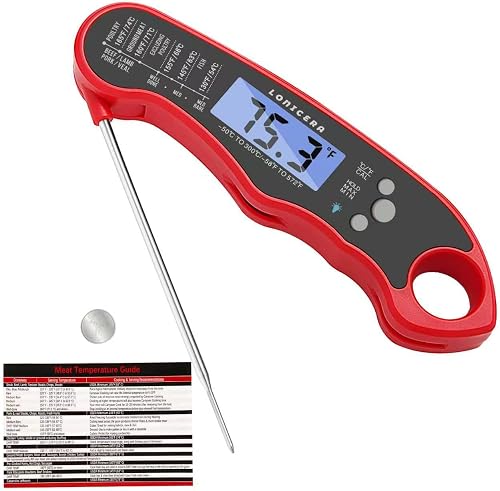
The Lonicera digital meat thermometer wins this matchup for most cooks. Its IP67 waterproof body can be rinsed under the tap, its 1-second read is quick enough for weeknight cooking, and its large backlit screen stays readable during dim grilling.
The ThermoPro option here, the TempPro TempSwift, is no slouch. It reads in 1 second, holds a reading with a lock function and runs up to 3000 hours on one AAA battery.
The thermo pro vs lonicera meat thermometer decision really comes down to what you value more: easy cleaning or a slightly tighter accuracy figure.
Both are folding instant read thermometers. Neither stays in the oven, and neither replaces a leave-in probe for long smokes.
This comparison looks at read speed, accuracy, waterproofing, display and battery life so you can choose the one that fits your cooking.

ThermoPro vs Lonicera at a glance
The Lonicera is the more forgiving tool around water and messy kitchens; the TempPro TempSwift edges ahead on accuracy and battery life. Here is how the two stack up on the specs that matter.
| Feature | Lonicera Digital Meat Thermometer | TempPro TempSwift |
|---|---|---|
| Response time | 1 second | 1 second |
| Accuracy | ±1°F | ±0.9°F |
| Waterproof rating | IP67 | IP65 |
| Probe | 4.3-inch 304 stainless steel | 4.3-inch food-grade stainless steel |
| Display | Large backlit, auto-rotating | 2-inch 180° auto-rotating backlit |
| Battery | CR2032 coin cell | 1 AAA, up to 3000 hours |
| Temperature range | -58°F to 572°F | Not published here |
| Extra functions | Hold, Max/Min, calibration | Lock, calibration, motion sleep/wake |
Both thermometers read in about a second, so speed won't separate them in daily use. The meaningful gaps are the waterproof rating and the accuracy figure.
Everything else is about how the tool feels in your hand and how you store it.
The TempPro model is sold under the TempPro brand rather than ThermoPro. Shoppers searching "thermo pro vs lonicera meat thermometer" usually mean this class of folding instant read thermometers, and these two are the closest match in this guide.
One more spec worth noting from the table: the Lonicera lists a measurement resolution of 0.1, so the readout moves in tenths of a degree. The TempPro lists the same 0.1 resolution.
That fine a step is more than most home cooks need, but it does mean neither display rounds away the small changes you see as meat approaches target temperature.
Read speed: does 1 second vs 1 second matter?
No, both claim a 1-second response, so speed is a tie on paper. A 1-second read is fast enough for steaks, chicken and burgers, and neither thermometer will leave you waiting with the grill open.
That speed matters when you're checking several pieces of meat or flipping between a hot pan and a cutting board. A slow thermometer forces you to hold the probe in the food longer, which lets heat escape and can overcook thin cuts.
What changes the real-world feel
The probe design does more for perceived speed than the stopwatch number. The TempPro uses a 4.3-inch food-grade stainless steel probe with a folding hinge, and the Lonicera uses a 4.3-inch 304 stainless steel probe with the same fold-out design.
Both turn on when you open the probe and sleep when you close it. The TempPro goes a step further with motion sensing, so it wakes when you pick it up and sleeps when you set it down.
That's a small convenience, but it adds up over a long grilling session.
The TempPro also lists a 1-second response time in its own specifications, so the marketing claim and the spec sheet agree. The Lonicera's description emphasizes speed alongside its wide temperature range, and its spec sheet puts response time at 2 seconds.
That's a small discrepancy worth knowing, though in either case the read completes before your hand gets uncomfortable over a hot grill.
If you're comparing this class against fancier wireless gear, our MEATER Plus vs MEATER Pro comparison covers the trade-offs of app-connected probes. For now, treat read speed as even and decide on the other features.
Accuracy: how tight do you need it?
The TempPro lists ±0.9°F and the Lonicera lists ±1°F, so the TempPro is marginally tighter on paper. In practice, both sit inside the range most home cooks need for safe and tasty meat.
A tenth of a degree is not something you'll notice when pulling a steak at medium rare. What matters more is whether the thermometer stays accurate over time, and both include a calibration function so you can correct drift.
When tighter accuracy pays off
If you cook sous vide, make candy or cure meat, a tighter accuracy figure gives you more confidence in the final number. The TempPro's ±0.9°F helps there, and its lock function lets you read the temperature away from the heat.
The Lonicera covers -58°F to 572°F, which stretches from frozen food to hot oil. That range makes it a practical choice for deep frying and candy making as well as grilled meat.
The TempPro's temperature range isn't published in the same detail, so lean on the Lonicera if you work at the temperature extremes.
For most people grilling chicken and steaks, ±1°F versus ±0.9°F won't change the outcome. The difference only shows up when you're working at the edge of a recipe's tolerance.
A candy recipe that calls for the softball stage, for example, leaves little room for error, and a tighter figure gives you a cleaner decision.
Waterproofing: IP67 vs IP65 explained
IP67 lets you rinse the Lonicera under running water; IP65 on the TempPro only resists splashes. That's the biggest practical difference between these two thermometers.
IP ratings have two digits. The first covers dust, the second covers water.
A second digit of 7 means the device can survive temporary immersion, and a 5 means it handles water jets but not immersion.
The Lonicera's IP67 rating means you can rinse the probe and body under the tap after checking raw chicken. The TempPro's IP65 rating tolerates a quick rinse under running water, but it is not built for submerging like the Lonicera's IP67.
Neither one should go in the dishwasher or sit in a sink of water.
Why this matters for food safety
Raw meat juices carry bacteria, and a thermometer that can't be rinsed properly is harder to keep clean between checks. If you probe chicken and then check a steak, a rinseable thermometer is the safer tool.
The Lonicera's hand-wash-only care instruction still applies, so don't submerge it. But a quick rinse under running water is within its rating, and that's enough for most home cooks.
Its outer material is a plastic body over the stainless probe, which is why the electronics survive a rinse while the metal stays easy to wipe.
The TempPro's care instruction is also wipe clean, so the difference isn't about whether either can be scrubbed. It's about how much water contact each one tolerates.
If your routine is probe, wipe, probe again, the TempPro keeps up fine. If your routine includes a rinse after every raw-meat check, the Lonicera is built for that.
Display and usability: which is easier to read?
Both have backlit, auto-rotating screens, so left-handed cooks and glove-wearers can read them at odd angles. The Lonicera's screen is described as large, and the TempPro's is a 2-inch 180° auto-rotating display.
The auto-rotating feature means the numbers flip to stay upright however you hold the thermometer. That's genuinely useful when you're reaching over a hot grill or wearing heat-proof gloves.
Both designs assume you might hold the tool at an awkward angle, and both correct for it.
Extra functions worth knowing
The Lonicera adds a hold function to lock the reading and a Max/Min function that tracks temperature extremes. Max/Min is handy when you want to know how hot a grill got or how cold a freezer dropped.
The TempPro offers a lock function for reading away from the heat and a calibration function. It also has a magnetic back for sticking to the fridge or grill, plus a hang hole for a hook.
The Lonicera doesn't list a magnet in its features.
If you often cook in dim light or at night, both backlights do the job. The Lonicera's larger screen may be easier to read from a distance, while the TempPro's compact 2-inch display keeps the body small.
Size and weight in the hand
The TempPro is 6.14 inches long and weighs in around the same as a large kitchen knife handle. The Lonicera is 6.1 inches long.
Both are compact enough to slip into an apron pocket or a drawer.
The TempPro's outer material is food-grade stainless steel and metal, while the Lonicera's body is ABS plastic. That's a materials difference more than a usability one, but it does affect how each feels when wet or greasy.
Metal grips differently than plastic, and the fold-out hinge on both means you'll handle the body, not the probe, when you open and close them.
Battery and storage: which is easier to live with?
The TempPro runs up to 3000 hours on one AAA battery, and the Lonicera uses a CR2032 coin cell. Battery type matters more than the hour count, because a coin cell is harder to find in a drawer at short notice.
The TempPro's motion sleep/wake stretches its battery and means it's ready when you pick it up. The Lonicera turns on when you open the foldable probe and off when you close it, which is simple and predictable.
Storage in a small kitchen
The TempPro has a magnetic back and a hang hole, so it can live on the fridge or a hook. The Lonicera folds shut for drawer storage but doesn't list a magnet.
In a small kitchen, the TempPro is easier to keep within reach.
Neither is a leave-in probe, so plan to store them somewhere dry rather than leaving them on the grill. A drawer or a magnetic spot on the fridge both work, as long as the probe stays closed and clean.
What the batteries mean for long cooks
A AAA battery is the kind you already keep in the junk drawer for remotes and toys. A CR2032 coin cell is smaller and often sold in multi-packs for watches and small electronics.
If you host big cookouts, the TempPro's standard battery means fewer surprises when the low-battery indicator appears.
The Lonicera includes one CR2032 battery in the box, along with an instruction sheet and a cooking temperature guideline. That guideline card is a small thing, but it's handy when you're learning target temps for different cuts.
The TempPro includes one AAA battery in the box.
Which should you buy?
Buy the Lonicera if you want the easiest thermometer to clean and a wide temperature range for candy and frying. Buy the TempPro TempSwift if tighter accuracy and long battery life matter more to you than rinsing under the tap.
The Lonicera's IP67 rating is the deciding feature for anyone who probes raw meat regularly. Its -58°F to 572°F range also covers deep frying and candy making, which many folding thermometers handle less comfortably.
The 1-second read and large backlit screen make it pleasant to use every day.
The TempPro wins on accuracy at ±0.9°F and on battery life at up to 3000 hours. Its lock function and magnetic back suit cooks who want the reading held away from the heat and the tool kept on the fridge.
If you mostly grill and smoke meat and don't need to rinse the probe, this is the better fit.
Who should pick each one
Pick the Lonicera if you cook chicken and other raw meat often and want a thermometer you can rinse clean. Pick the TempPro if you do long cooks, want the reading locked on screen and prefer a standard AAA battery.
Home cooks who bake a lot may lean Lonicera for the wide temperature range and the Max/Min tracking. Grill and smoker owners may lean TempPro for the magnetic mount and the motion wake, which suit a tool that moves between counter and grill.
The split is less about quality than about routine.
If you're still deciding between probe styles, our guide to dual probe vs 4 probe meat thermometers explains when a leave-in probe beats a folding instant read. And if you're weighing app-connected gear against folding models, wireless vs wired meat thermometers breaks down the trade-offs.
The verdict on thermo pro vs lonicera
For most cooks, the Lonicera digital meat thermometer is the better buy. Its IP67 waterproof rating, 1-second read and wide temperature range make it the more versatile tool in a real kitchen.
The thermo pro vs lonicera meat thermometer choice flips only for cooks who prize accuracy and battery life. The TempPro TempSwift's ±0.9°F and 3000-hour battery are real advantages for long cooks and precise recipes.
Either way, learn the basics before your first cook. Our guide on how to use a ThermoPro thermometer walks through calibration and probe placement, and the same steps apply to the Lonicera.
One last note: neither of these is a leave-in probe. Use them for quick checks and pull them out before closing the lid.
That habit keeps the probe accurate and the reading reliable.
Frequently asked questions
Is a ThermoPro meat thermometer waterproof?
The TempPro TempSwift in this comparison carries an IP65 rating, and the maker says you can clean the thermometer and probe under running water. Avoid soaking or submerging it, since IP65 is not designed for immersion.
How accurate should an instant read thermometer be?
Look for ±1°F or tighter for everyday cooking. The Lavatools Javelin PRO Classic claims ±0.5°F after laboratory calibration, while the Lonicera lists ±1°F and the TempPro lists ±0.9°F.
Can I leave a digital meat thermometer in the oven?
No. These are instant read thermometers meant for quick spot checks with the probe tip in the food.
Pull the thermometer out before closing the oven or grill lid, or use a leave-in probe thermometer instead.
Which is easier to clean, the Lonicera or the ThermoPro?
The Lonicera carries an IP67 rating and can be rinsed under running water. The TempPro TempSwift is IP65, so wipe it clean instead.
Neither one should go in the dishwasher.
Do these thermometers work for candy and deep frying?
The Lonicera covers -58°F to 572°F, which handles candy, oil and grilled meat. The TempPro and Lavatools are built around meat and general cooking, so check their temperature range against your recipe before relying on them for hot oil.