Dual Probe vs 4 Probe Meat Thermometer: Which Do You Need?
A dual probe meat thermometer suits meals with one or two foods to monitor; choose 4 probes when you often cook several foods at once. More probes give you more simultaneous readings, but only help if you have enough food to monitor.
On this page (8 sections)
- What does a dual probe meat thermometer do?
- When is a 4 probe meat thermometer worth it?
- How many probes do your usual meals need?
- Is probe count more important than connectivity?
- Which dual probe thermometer fits a smaller cook?
- Which 4 probe thermometer fits a larger cook?
- How should you choose between two and four probes?
- Which probe count should you buy?
A dual probe meat thermometer suits meals with one or two foods to monitor; choose 4 probes when you regularly cook several foods or portions at once. More probes give you more simultaneous readings, but only help if you have enough food to monitor.
For two steaks at different doneness levels, or a roast and another food, two probes can cover the meal. A larger grill or smoker cook with several meats is where four probes can help you monitor each item at once.
This guide compares probe count, cooking habits and four options. For a broader look at app alerts and wireless features, see what smart meat thermometers do.
What does a dual probe meat thermometer do?
A dual probe thermometer monitors two foods or locations at the same time. Depending on the model and setup, you can use one probe per protein or portion, then follow both readings in the app or on the device.
That is useful when two foods have different cook times. You can track chicken and steak separately, or monitor two roasts that may finish at different times.
Two probes do not automatically mean twice the accuracy. They add separate readings, while sensor design and placement still matter.
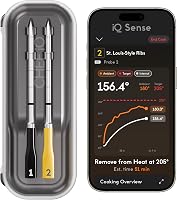
The CHEF iQ Sense 2-Probe includes two ultra-thin probes and a hub, with app cooking guidance and WiFi monitoring. The MEATER Pro Duo also monitors two foods, using its app-based system and WiFi connectivity.
When is a 4 probe meat thermometer worth it?
A 4 probe thermometer is worth considering when you often cook three or four items at once. It gives you a separate reading for each probe, which can help on a busy smoker, a large grill or a holiday meal with several proteins.
Four probes can also help when one large cook has different cuts or portions that may finish at different times. You can monitor them together instead of rotating one or two probes among the food.
The trade-off is practical: four probes need more placement and organization. If you rarely cook more than two items, the extra capacity may sit unused.
The CHEF iQ Sense 4-Probe includes four probes and a hub, with app-based cooking guidance and WiFi monitoring. ThermoMaven's Sub-1G 4-Probe includes four probes and a display base, so readings can be viewed on the base as well as through its app.
How many probes do your usual meals need?
Choose based on the number of separate foods you want to monitor at once, not the size of the thermometer's probe count alone.
| Your usual cook | Probe count to consider | Why |
|---|---|---|
| One roast or whole bird | 1 or 2 | One probe may cover the main item; a second can track another food or area |
| Two steaks with different targets | 2 | Each steak can have its own reading |
| Two proteins with different cook times | 2 | Track both without shifting a probe between foods |
| Three or four separate items | 4 | Keep readings for each item visible together |
| Large smoker cook with several cuts | 4 | More probes help manage staggered finish times |
A probe monitors the food where you place it, so probe count is not a substitute for choosing the right spot. Follow the thermometer instructions for placement and minimum insertion depth.
If you mostly cook one item, a single probe may be enough. If you cook two different foods, two probes reduce the need to move a probe during the cook.
Is probe count more important than connectivity?
Probe count answers how many readings you can track, while connectivity affects where you can monitor them. Decide how many items you cook first, then compare how the thermometer sends readings to you.
Some models rely on an app, while others include a display base. The MEATER Pro Duo is designed for app-based control and WiFi connectivity, and it does not have a built-in display.
ThermoMaven's 4-probe model has a display base and an app.
WiFi, Bluetooth and other wireless systems work differently. If you want more background, read whether wireless meat thermometers need WiFi and how far a wireless meat thermometer can reach.
Also consider the cooking setting. If you'll use a probe in an oven, check that the model supports that use and follow its temperature limits.
Our guide to using a wireless meat thermometer in the oven covers the main checks.
Which dual probe thermometer fits a smaller cook?
For two-food meals, compare the app and monitoring style as well as the probe count. Both of these models have two probes, but their features differ.
CHEF iQ Sense 2-Probe
The CHEF iQ Sense 2-Probe suits cooks who want two probes with a hub, app guidance and WiFi monitoring. CHEF iQ says its probes can handle heat up to 1000°F and run for up to 50 hours on a full charge.
It includes real-time temperature updates, flip reminders, rest timers and estimated cooking times. The CHEF iQ app also offers presets and video-guided recipes.
Choose it if you want to track two foods and use app guidance. If you often prepare more than two items, compare the CHEF iQ Sense 4-Probe in our 4-probe roundup.
MEATER Pro Duo
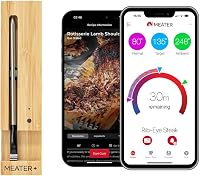
The MEATER Pro Duo suits cooks who prefer an app-based two-probe setup. Its base connects to the probes by Bluetooth and uses WiFi to pair with the MEATER app for full functionality.
It includes estimated cook and rest times, guided cooking and real-time alerts. Since it has no built-in display and is designed for app use, make sure that approach fits how you want to monitor a cook.
For general setup steps, see how to use a wireless meat thermometer.
Which 4 probe thermometer fits a larger cook?
Choose between 4-probe models by checking how you want to see the readings and connect to the probes. Both models below include four probes, and ThermoMaven also lists a display base.
CHEF iQ Sense 4-Probe
The CHEF iQ Sense 4-Probe suits cooks who want four probes in the CHEF iQ app and hub system. Its features include real-time updates, estimated cooking times, rest timers and guided recipes.
CHEF iQ says the probes can handle heat up to 1000°F and run for up to 50 hours on a full charge. The hub can charge all four probes simultaneously.
This is a direct fit if you want the CHEF iQ app workflow and need four simultaneous readings. If you only cook two items at a time, the 2-Probe version covers that smaller routine.
ThermoMaven Sub-1G 4-Probe
The ThermoMaven Sub-1G 4-Probe suits cooks who want four probes and a display base. It can show real-time readings on the base, and the app is available for additional control.
ThermoMaven describes its system as using Sub-1G connectivity, with a stated range of 3000 ft unobstructed and 700 ft in obstructed environments. Range depends on the setting, so treat those figures as the brand's stated conditions rather than a promise for every home or yard.
Choose it if a base display matters and you want four readings for a larger cook. If app-based monitoring and a hub are enough, the CHEF iQ 4-Probe is another option.
How should you choose between two and four probes?
Pick 2 probes if most meals have one or two foods to monitor. Pick 4 if three or four separate items regularly cook together and you want to see their readings at once.
Think through your last few cooks. If you usually made one roast or two steaks, four probes probably add little.
If you regularly smoke several cuts or cook a full spread with different timing, four probes can make monitoring simpler.
Also weigh the display and connection style. A phone-based app suits cooks who want alerts and guidance there, while a display base gives you another way to see readings.
For more options by probe count, compare our best 4-probe wireless meat thermometers and best smart meat thermometers. If you're deciding between a wired and wireless setup, read wireless vs wired meat thermometers.
Which probe count should you buy?
A dual probe meat thermometer is the practical choice for one or two foods at a time. Choose four probes when several items regularly share the grill, oven or smoker and you want separate readings for each.
If you want an app-focused setup for two foods, compare the CHEF iQ Sense 2-Probe and MEATER Pro Duo. For bigger cooks, compare the CHEF iQ Sense 4-Probe with ThermoMaven's display-base option.
If you're still deciding on a wireless model, start with our guide to what to look for in a wireless meat thermometer.
Frequently asked questions
Is a dual probe meat thermometer enough for a family?
A dual probe thermometer can be enough if you usually cook one or two large items, or two foods at once. Choose 4 probes if family meals often include several separate cuts, different doneness targets or a larger cook where you want readings from multiple spots.
Can you use 2 probes in one piece of meat?
You can use two probes to monitor separate areas, but check the thermometer's app or instructions for how it handles multiple readings. Two probes are often more useful for two separate foods, especially when they need different cook times or doneness targets.
Do 4 probe thermometers need four pieces of meat?
No. A 4 probe thermometer can monitor fewer than four items, so you do not have to fill every probe.
The extra probes are most useful when you often cook several foods or portions at once; otherwise, a dual probe model may fit your routine better.
What matters more, probe count or wireless range?
Probe count matters when you need several simultaneous readings, while range matters when you want to monitor from farther away. Decide how many foods you cook at once first, then compare connectivity and whether you want app-based monitoring or a display on the base.