Wireless vs Wired Meat Thermometer: Which Do You Need? (October 2026)
Choose wireless for remote checks and wired for a direct probe-to-display connection. The wireless vs wired meat thermometer choice depends on where you cook, how you want to check temperatures and how many foods you monitor.
On this page (9 sections)
- Wireless vs wired meat thermometer: what is the main difference?
- Which type suits your cooking setup?
- Does wireless mean you can monitor from anywhere?
- Which one is easier to set up and check?
- How many probes do you need?
- Which format should you choose for your routine?
- What should you check before buying?
- What mistakes should you avoid with either thermometer?
- Wireless vs wired meat thermometer: which do you need?
For a wireless vs wired meat thermometer, choose wireless if you want remote checks and wired if you prefer a probe connected directly to a nearby display. Your cooking location, probe needs and preferred way to check temperatures make the choice.
Wireless models send readings to a phone, receiver or screen without a cable running from the probe to the display. Wired models connect the probe to a display with a cable that exits the cooking area.
Neither format is automatically easier or more accurate. Check where the display sits, how many probes you need, how the thermometer connects and whether its probe suits your cooking temperature.


Wireless vs wired meat thermometer: what is the main difference?
A wireless thermometer sends readings without a probe cable running to the display; a wired thermometer uses that cable to connect the probe and display. Both let you monitor food while it cooks.
Wireless models may use Bluetooth, WiFi or RF. Some pair with an app, while others send readings to a dedicated receiver or screen.
With a wired model, the probe stays physically linked to its display. The screen is ready nearby, but the cable needs a clear route through or around the cooking area.
The format alone doesn't determine temperature accuracy. Probe placement and the model's stated accuracy and temperature limits matter.
For a closer look at this point, see whether wireless meat thermometers are accurate.
Which type suits your cooking setup?
Choose the format that fits the distance between your cooker and where you want to read the temperature. Wireless can help when you step away, while wired works well when you stay near the display.
In an oven, a wireless probe avoids routing a cable through the door. With a wired thermometer, check the manual for a safe cable path that won't be pinched, touch a hot surface or interfere with the door.
At a grill or smoker, consider how often you walk inside and whether you can see the display from where you stand. If you stay close, a cable may be easy to manage; if you prepare food indoors, remote alerts can reduce trips back to the cooker.
The guide to using a wireless meat thermometer explains probe placement and setup. For oven use, read whether a wireless meat thermometer can go in the oven.
Does wireless mean you can monitor from anywhere?
No, wireless range depends on the connection and the space between the probe and receiver or phone. Walls, appliances and device placement can affect whether the signal reaches you.
Bluetooth connects the thermometer to a phone or compatible device. Some models add a repeater or display, while RF models may include a separate receiver.
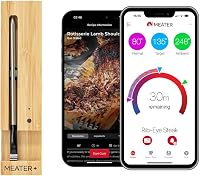
MEATER Plus pairs with the MEATER app and has a Bluetooth repeater in its charger. TempPro TempSpike uses RF and includes a large screen, so you can read 2 probe temperatures without checking a phone.
A claimed range won't tell you how a signal will behave in every home or yard. If you cook in a detached garage or across several walls, think about where the receiver or phone will be and how you'll notice a lost connection.
Read how far a wireless meat thermometer can reach before choosing a model for a long-distance setup. For a broader look at phone-connected options, see smart meat thermometers and how to choose one.
Which one is easier to set up and check?
A wired thermometer needs a safe cable route; a wireless model may need app pairing or a receiver. The easier choice depends on whether you prefer a direct connection, a phone or a separate screen.
Wireless setup varies by connection type. Bluetooth models may need to pair with an app, while an RF thermometer with a dedicated screen can avoid phone setup.
TempPro TempSpike has an RF connection, a large display and no app setup. MEATER Plus uses an app for guided cooking, alerts and estimated finish times, so it suits someone who wants help following a cook.
A wired model avoids wireless pairing, but its cable takes attention. Keep it away from burners, flames, sharp edges and door hinges, and follow the instructions for the cable and probe temperature limits.
If a wireless unit stops connecting, follow these steps for a wireless meat thermometer that won't connect. If you want to know whether a wireless model can work without a phone, see how to use one without a phone.
How many probes do you need?
Choose enough probes for the foods and cooking zones you want to monitor at the same time. One probe can suit a single roast, while multiple probes help you watch separate cuts or areas of a grill.
Probe count is a model choice, not a wireless or wired feature. Some wireless thermometers support several probes, and wired options can do the same.
TempPro TempSync 650 has 2 probes and displays both temperatures. Weber iGrill 3 can monitor up to 4 cuts of meat, but it mounts to compatible Genesis II or Spirit II grills with an iGrill 3 Ready plate.
If you are deciding between two and four probes, compare dual-probe and 4-probe meat thermometers. If you want to keep a probe in food during a cook, browse wireless leave-in meat thermometers.
Which format should you choose for your routine?
Choose wireless for remote checks and fewer cables; choose wired if you stay near the display and want a direct connection. Start with where you usually cook, then decide whether you need an app, receiver or several probes.
Wireless vs wired meat thermometer: who should choose wireless?
Choose wireless if you leave the cooker to prepare food, tend other tasks or move indoors during a long cook. It also suits setups where a probe cable would cross an oven door or grill opening.
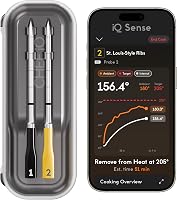
Pick an app-connected model if you want alerts or cooking guidance on your phone. MEATER Plus has one wire-free probe and app guidance, while TempPro TempSync 650 combines two probes, an app and a display on the unit.
Wireless may be a poor fit if you don't want to pair a phone, rely on a signal or keep a receiver charged. In that case, a simple wired model or an RF thermometer with a standalone screen may be more comfortable.
Wireless vs wired meat thermometer: who should choose wired?
Choose wired if you usually stay close to the cooker and want the probe connected to a visible display. A cable can be straightforward when the display is nearby and the route stays clear.
Wired may be a poor fit if the cable must cross a walkway, get caught in a door or sit near intense heat. Check the manual before use, since probe and cable limits vary by model.
If you already have a wired thermometer that suits your routine, there's no need to change formats. Consider wireless when you want alerts from another room or a cable-free probe in the cooking area.
Which format fits an oven, grill or smoker?
Choose based on the probe's temperature limits and the layout of your cooker. A wireless connection doesn't make a probe safe for every heat source.
Don't confuse the maximum internal meat temperature with the maximum ambient temperature around the probe. TempPro TempSpike is specified for internal meat temperatures up to 212°F, while its ceramic section can withstand smoker temperatures up to 1050°F; its probe shouldn't be used to measure ambient temperature directly.
For other models, check the instructions for probe placement and cooking limits. If a wireless model needs its charger or receiver nearby, place it where the connection can reach without exposing it to heat.
What should you check before buying?
Compare connection, display, probe count and temperature limits before choosing a thermometer. These details affect day-to-day use more than the wireless or wired label.
First, decide where you'll read the temperature. An app can provide alerts and guidance, a dedicated screen avoids frequent phone checks, and a wired display can suit a cook who stays close.
Next, count the foods or cooking zones you want to track at once. One probe may be enough for a roast, while several cuts or a separate grill reading can call for more.
Then check placement, care and compatibility. MEATER Plus is dishwasher safe according to its care instructions, while TempPro TempSpike is wipe-clean.
Weber iGrill 3 is designed to mount on certain Weber grills, and its app has device requirements, so confirm that your grill and phone suit it.
For other buying factors, visit meat thermometer buying basics. For a wider look at app features and connections, start with smart meat thermometers.
What mistakes should you avoid with either thermometer?
Avoid choosing by range or probe count alone, and follow the instructions for placement, heat and care. A suitable connection can't make up for a probe used outside its stated limits.
Don't assume all wireless thermometers connect the same way. Bluetooth, RF and WiFi have different setup needs, and some models rely on a phone while others include a separate screen.
Don't place a probe based only on the display or cable position. Follow the model's instructions so the sensing area sits correctly in the food, and keep any wired lead away from heat, sharp edges and moving parts.
Don't expose a probe or display to heat or water beyond its care instructions. The Weber iGrill 3 should not be submerged.
TempPro TempSpike's stated waterproof rating applies to its probe. Check the exact cleaning guidance for each component.
Wireless vs wired meat thermometer: which do you need?
Choose wireless if you want readings while you move away from the cooker; choose wired if you stay nearby and prefer a direct probe-to-display connection. Then narrow your pick by probe count, display style, connection and temperature limits.
For app guidance with one wire-free probe, consider MEATER Plus. For two wireless probes and a standalone screen, consider TempPro TempSpike; for up to four probes on a compatible Weber grill, consider the iGrill 3.
If your main question is probe capacity, compare dual-probe and 4-probe thermometers before deciding. For a broader feature checklist, read what to look for in a wireless meat thermometer.
Sources
Frequently asked questions
Is a wireless or wired meat thermometer better?
Wireless suits cooks who want to move away from the grill or oven and check temperatures on a phone or receiver. A wired thermometer suits cooks who prefer a probe connected to a nearby display.
Probe capacity, alerts and the cooking setup matter more than the label alone.
Can a wireless thermometer work without WiFi?
Some wireless meat thermometers use Bluetooth or RF rather than WiFi. Check how the exact model connects and whether it needs a phone, receiver or both.
Bluetooth range can depend on walls and placement, while a dedicated RF receiver may be easier to check from another room.
Do wired meat thermometers need to stay outside the oven?
The probe cable typically runs from the food to a display outside the cooking area, but follow the thermometer's instructions for cable routing and temperature limits. Keep the cable clear of hot surfaces, doors and moving parts, and don't assume every probe or cable is oven safe.
Are wireless meat thermometers accurate?
Accuracy depends on the specific thermometer and how the probe is placed. Check the stated accuracy and temperature limits, insert the probe as directed, and compare readings with a trusted thermometer if you suspect a problem.
Wireless connection type alone doesn't determine temperature accuracy.
Which thermometer is easier to use for a smoker?
Either style can suit a smoker if its probe and cable or wireless connection fit the setup. Wireless models avoid a probe wire crossing the smoker door, while a wired unit keeps the probe connected to its display.
Check ambient temperature limits and range before choosing.