10 Best Wireless Leave-In Meat Thermometers (October 2026)
The best wireless leave-in meat thermometers include the TempPro TempSync 1000FT for no-app cooking with 4 probes, the ThermoMaven 3000FT No-App for long-range no-app monitoring, and the TempPro TempSync 650 for app alerts with a receiver display.
On this page (4 sections)
The TempPro TempSync 1000FT is the best leave-in meat thermometer for most cooks because its receiver handles four probes without an app. For a phone-free base with a longer stated range, consider ThermoMaven; for Wi-Fi app alerts, GoveeLife is the better fit.
A leave-in thermometer lets you monitor food as it cooks, so you can spend less time opening the oven, grill or smoker to check progress. The right model depends on how many temperatures you track and whether you want readings on a receiver, a phone or both.
If you're still comparing connection types and probe designs, start with our guide to smart meat thermometers and how to choose. This roundup compares 10 options by their stated probe count, connection method, display and cooking alerts.
Our picks at a glance
-
1

-
2

-
3
- 4
 Check it
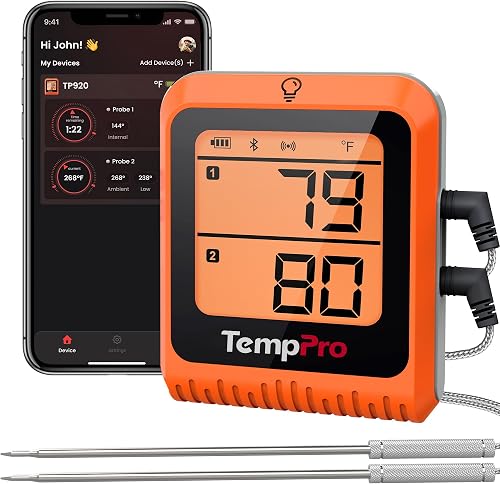
TempPro TempSpike 2000FT 2-Probe
Best for wire-free probes and rotisserie cooks - 5
 Best for Wi-Fi app cooking guidanceCheck it
- 6
 Best for Wi-Fi monitoring across 4 foodsCheck it
- 7
 Best for four probes with phone-free checksCheck it
- 8
 Best for four probes over BluetoothCheck it
- 9
 Best for compatible Weber gas grillsCheck it
- 10
 Best for step-by-step grilling alertsCheck it
How we chose leave-in meat thermometers
The best leave-in meat thermometer for you depends on probe count, how you want to receive readings and how you cook. We compared the listed features and specifications for those needs, including receiver displays, app access, stated range and probe design.
A stated wireless range is a maker's maximum, not a promise that the signal will travel that far through walls, appliances or other obstacles. For help judging signal limits around your setup, see how far a wireless meat thermometer can reach.
No-app models suit cooks who prefer a separate receiver and want to avoid pairing a phone. Wi-Fi and Bluetooth options can send alerts to an app, but they depend on the connection and setup each model requires.
| Product | Best for | Probe count | Connection | Receiver display | Our score |
|---|---|---|---|---|---|
| TempPro TempSync 1000FT | no-app cooking with 4 probes | 4 | RF | Backlit LCD | 8.2 |
| ThermoMaven 3000FT No-App | long-range no-app monitoring | 2 | Sub-1G | 8.0 | |
| TempPro TempSync 650 | app alerts with a receiver display | 2 | Bluetooth | 8.0 | |
| TempPro TempSpike 2000FT 2-Probe | wire-free probes and rotisserie cooks | 2 | RF | 7.9 | |
| GoveeLife WiFi 2-Probe | Wi-Fi app cooking guidance | 2 | Wi-Fi and Bluetooth | 7.9 | |
| INKBIRD IBBQ-4T | Wi-Fi monitoring across 4 foods | 4 | 2.4 GHz Wi-Fi | 7.7 | |
| INKBIRD WiFi 4-Probe | four probes with phone-free checks | 4 | Wi-Fi, Bluetooth or non-phone mode | 7.6 | |
| INKBIRD IBT-4XS | four probes over Bluetooth | 4 | Bluetooth | 7.6 | |
| Weber iGrill 3 | compatible Weber gas grills | Bluetooth | 7.7 | ||
| Weber Connect Hub | step-by-step grilling alerts | Bluetooth | 7.2 |
The best wireless leave-in meat thermometers
These picks cover no-app receivers, app-connected monitoring and different probe counts. The score weighs listed specs and features against the needs of someone shopping for a leave-in thermometer.
TempPro TempSync 1000FT: Best for no-app cooking with 4 probes
- RF connection
- Up to 1,000 ft stated range
- 4 color-coded probes
- Receiver with backlit display
The receiver and four probes suit cooks who want to monitor several temperatures without using a phone app. Presets and audible and visual alerts add guidance at the base.
Pros
- No app setup
- Four color-coded probes
- Displays current and target temperatures
Cons
- RF connection rather than phone-based remote monitoring
- Four probes may be more than a single-cut cook needs
The TempPro TempSync 1000FT is a strong fit if you want to watch several temperatures without opening an app. It includes 4 color-coded probes and a receiver with a backlit screen that displays current and target readings.
TempPro says its RF connection can reach up to 1,000 ft. The unit also offers 10 USDA-recommended presets, multiple doneness levels, and an alarm that beeps and flashes as temperatures approach the set range.
The receiver-based design suits a cook who wants to check readings at a glance while preparing other food. Choose it for multiple cuts or a mix of food and cooker temperatures, and consider a two-probe model if you rarely need more.
ThermoMaven 3000FT No-App: Best for long-range no-app monitoring
- Sub-1G connection
- Up to 3,000 ft stated range
- 2 probes
- Standalone LCD base
A standalone base and two probes give you a phone-free way to keep tabs on separate cuts. ThermoMaven states a range of up to 3,000 ft, though real conditions can affect signal reach.
Pros
- No app or account needed
- Standalone LCD base
- Two thin probes
Cons
- Two probes instead of four
- Long stated range does not guarantee the same reach through walls or appliances
ThermoMaven suits cooks who want a standalone base and no app setup. It has 2 thin probes and a large LCD display, so you can track separate foods from the base.
ThermoMaven states a range of up to 3,000 ft using Sub-1G wireless technology. That figure can help compare models, but walls and other obstacles may reduce the useful range in your cooking area.
The maker also describes six sensors per probe and NIST certification. Pick this model when you value a phone-free setup and long stated range; choose a four-probe option if you routinely cook more than two items at once.
TempPro TempSync 650: Best for app alerts with a receiver display
- Bluetooth connection
- Up to 650 ft stated range
- 2 probes
- Displays both temperatures on the unit
The two-probe set pairs app alerts with a display that shows both readings. That gives you phone notifications while keeping a quick temperature check on the unit.
Pros
- App setup does not require registration
- Two readings appear on the unit
- Rechargeable
Cons
- Bluetooth range varies with surroundings
- Requires an app for custom targets and pre-alarms
The TempPro TempSync 650 pairs a receiver display with Bluetooth app alerts. Its two probes can monitor separate cuts or food and grill temperatures at the same time.
The unit displays both temperatures, which is useful when you want a quick check without pulling out your phone. In the app, you can set target temperatures and pre-alarms; TempPro says setup requires no registration or Wi-Fi tinkering.
The stated range is up to 650 ft, though real-world reach depends on the layout and interference. Choose it if phone notifications matter but you still want readings visible on the thermometer itself.
TempPro TempSpike 2000FT 2-Probe: Best for wire-free probes and rotisserie cooks
- RF connection
- Up to 2,000 ft stated range
- 2 wire-free probes
- IPX8 probe rating
Two wire-free probes avoid cords running from the meat to the receiver, a useful fit for rotisserie cooking. Its screen shows both probe and barbecue temperatures.
Pros
- No app or sign-up required
- Wire-free probes
- Displays meat and barbecue temperatures
Cons
- Only two probes
- No app for remote phone alerts
The TempPro TempSpike 2000FT uses two wire-free probes, which avoid cords between the food and receiver. That makes it a practical option for rotisserie cooking, where loose probe wires can be awkward.
Its large display shows both probe temperatures and two barbecue temperatures, so you can check cooking progress at the unit. TempPro states an RF range of up to 2,000 ft and an IPX8 rating for the probes.
This model needs no app or sign-up, but it has only two probes and does not provide phone-based remote alerts. Choose it when wire-free probes matter more than app control or a four-probe setup.
GoveeLife WiFi 2-Probe: Best for Wi-Fi app cooking guidance
- Wi-Fi and Bluetooth
- 2 probes
- App alerts and temperature tracking
- LCD base
GoveeLife combines a display base with Wi-Fi and Bluetooth app control. Its app offers temperature recommendations and alerts, which may suit cooks who want guided monitoring.
Pros
- App alerts and temperature tracking
- Wi-Fi and Bluetooth connectivity
- Display base with magnetic mounting
Cons
- Uses an app for remote control and guidance
- Two probes
GoveeLife suits cooks who want Wi-Fi and Bluetooth app monitoring along with a display base. The two probes can track separate items, and the GoveeHome app provides alerts and temperature tracking.
Its app includes 28 temperature recommendations for different meats based on USDA presets. The base has a 10-function LCD screen and a magnetic mount, giving you a local way to check readings as well.
GoveeLife describes a 25-minute probe charge and up to 48 hours of continuous use. Choose it if app guidance and connectivity matter to you, and confirm the base and probe placement instructions for your cooking setup.
INKBIRD IBBQ-4T: Best for Wi-Fi monitoring across 4 foods
- 2.4 GHz Wi-Fi
- 4 color-coded probes
- Temperature graph in the app
- High and low alarms
Four colored probes and Wi-Fi app access suit longer cooks with several foods to monitor. The app includes temperature graphs, while the unit offers high and low alarms.
Pros
- Four color-coded probes
- Wi-Fi app monitoring
- Temperature graph and calibration
Cons
- Requires the Inkbird Pro app and 2.4 GHz Wi-Fi
- The plastic unit should stay below 176°F
The INKBIRD IBBQ-4T offers four color-coded probes and Wi-Fi app monitoring. Its app can show temperature graphs and supports calibration, which helps cooks who want to review how a longer cook progressed.
The unit also supports a timer and high and low temperature alarms. INKBIRD says the rechargeable battery lasts about 26 hours per full charge, and its plastic unit should not be placed where temperatures exceed 176°F.
This model fits cooks who want several probe readings and remote app access over 2.4 GHz Wi-Fi. If you prefer checking temperatures without a phone, compare the receiver-based TempPro or ThermoMaven models above.
Weber iGrill 3: Best for compatible Weber gas grills
- Bluetooth app connection
- Up to 4-probe capacity
- 2 color-coded probes included
- Fits specified Genesis II and Spirit II grills
The iGrill 3 mounts to compatible Genesis II, Genesis II LX and Spirit II gas grills with an iGrill 3 Ready plate. It connects through the Weber app and can monitor up to four cuts.
Pros
- Mounts to specified compatible Weber grills
- Up to four-probe capacity
- App notifications
Cons
- Requires a compatible grill plate
- The unit is not waterproof
The Weber iGrill 3 makes sense for owners of specific Weber gas grills. It mounts to Genesis II, Genesis II LX and Spirit II models with an iGrill 3 Ready plate on the side table.
It connects to the Weber app over Bluetooth and notifies you on a smart device when food reaches the chosen temperature. Two color-coded probes come with it, and the unit can support up to four probes.
This setup is tied to grill compatibility, so check your grill before choosing it. Weber also says the iGrill 3 is not waterproof, which matters when you decide where to mount and store it.
INKBIRD WiFi 4-Probe: Best for four probes with phone-free checks
- 4 probes
- Wi-Fi, Bluetooth and non-phone modes
- Backlit LCD charging stand
- App temperature and time alerts
This INKBIRD model offers four probes and three connection modes, including a non-phone option. Its stand shows all four readings, while the app adds alerts and graph tracking.
Pros
- Four probes
- Non-phone mode available
- Charging stand displays all probe readings
Cons
- The base should stay below 176°F
- Wi-Fi mode requires 2.4 GHz
The INKBIRD WiFi 4-Probe gives you four probes and a choice of Wi-Fi, Bluetooth or non-phone connection modes. Its charging stand has a backlit screen that shows the current temperature for each probe.
The app offers temperature and time alerts, graph tracking and preset or custom menus. INKBIRD states up to 25 hours of use after a recharge and says the base should remain below 176°F.
Choose it if you want four probes but also value a phone-free way to check readings. The temperature display and connection modes offer flexibility, though app functions require setup with the INKBIRD app.
INKBIRD IBT-4XS: Best for four probes over Bluetooth
- Bluetooth connection
- 4 probes
- Magnetic base
- Rotating display
Four probes cover several foods or a mix of meat and cooker temperature. The base has a magnetic back and a display that rotates for easier viewing from different angles.
Pros
- Four probes including an ambient probe
- Magnetic base
- Rechargeable battery
Cons
- Bluetooth range is stated up to 150 ft outdoors
- Probes must be fully inserted in the unit
The INKBIRD IBT-4XS includes four probes, one of them an ambient probe for monitoring the cooker. A magnetic back lets you attach the base to a nearby metal surface, and its screen can rotate for easier viewing.
The app can show temperature graphs, while the stated Bluetooth range is up to 150 ft outdoors. INKBIRD notes that probes need to be firmly inserted into the thermometer ports to avoid inaccurate readings.
This is a useful layout for cooks who want separate readings across several foods and the cooking environment. Choose it if Bluetooth app access works for your setup and you can keep the base within range.
Weber Connect Hub: Best for step-by-step grilling alerts
- Bluetooth connectivity
- Flip and serve notifications
- Food readiness countdown
- Step-by-step assistance
The Connect Hub focuses on guided grilling, with step-by-step assistance and phone notifications for flipping, serving and food readiness. Weber says it works with any grill.
Pros
- Works with any grill
- Readiness countdown and estimated cook time
- Doneness alerts
Cons
- Bluetooth connection
- Best suited to cooks who want app guidance
The Weber Connect Hub is designed for app-guided grilling. It sends flip and serve notifications, a food-readiness countdown and estimated cook time to your phone.
Weber says it works with any grill and provides step-by-step assistance from setup through serving. Its focus is guided cooking, so compare it with models that put more emphasis on probe count, a local receiver display or no-app operation.
Choose the Connect Hub if reminders and cooking guidance matter more to you than a dedicated standalone temperature display. For help with the basics, read how to use a wireless meat thermometer.
Which leave-in thermometer features matter most?
The right feature set depends on how many items you cook, where you want to see readings and whether your setup needs an app. Start by matching the thermometer to those habits rather than choosing by range alone.
How many probes should a leave-in meat thermometer have?
Two probes can monitor two foods or, on some models, one food and the cooker temperature. Four probes are useful when you cook several cuts at once or want readings from multiple spots.
More probes add flexibility, but they can be unnecessary for a single roast. Compare dual-probe and 4-probe meat thermometers if you're unsure which layout fits your meals.
Should you choose a no-app receiver or an app?
A receiver is convenient if you want to check temperature without opening your phone or using an account. TempPro TempSync 1000FT and ThermoMaven both offer a no-app approach.
An app can add alerts, graphs and guided settings, but the exact features vary. For more on the trade-offs, see our guide to whether wireless meat thermometers need Wi-Fi.
Can wireless probes stay in an oven or smoker?
Only leave a probe in an oven or smoker when its instructions and heat limits allow it. The probe and the base may have different limits, so place each part according to its own guidance.
Wired, wireless and wire-free probes also have different placement needs. Read whether you can put a wireless meat thermometer in the oven before using one for an oven cook.
Does a longer stated range mean better coverage?
A longer stated range can help when the receiver or phone is far from the cooker, but walls and obstacles affect real coverage. Compare the connection type and the physical layout between your cooking area and where you plan to monitor it.
RF, Sub-1G, Bluetooth and Wi-Fi work differently, and a range figure alone doesn't tell you how a model will perform in your home. If connection issues come up, our guide to wireless meat thermometers that won't connect covers common checks.
Which wireless leave-in meat thermometer should you choose?
Choose the TempPro TempSync 1000FT if you want a no-app receiver and four probes for several foods. Pick ThermoMaven for its two-probe, standalone-base setup and longer stated range, or GoveeLife for app alerts and Wi-Fi.
A two-probe model can be enough for a roast and cooker temperature, while four probes suit larger cooks. Before buying, confirm the probe's cooking limits and decide whether you want temperature readings on a base, a phone or both.
For more choices by cooking style, browse our best wireless smoker thermometers and best oven-safe wireless meat thermometers roundups.
Our top 3 picks at a glance
-
1
-
2
-
3
Frequently asked questions
What is a leave-in meat thermometer?
A leave-in meat thermometer has a probe that stays in food during cooking and sends temperature readings to a display or phone. Some models use wired probes, while others use wireless probes.
Check the probe and ambient heat limits for your cooking method before leaving it in an oven, grill or smoker.
Can you leave a wireless meat thermometer in the oven?
Yes, if the probe is designed for the oven and you follow its heat limits and placement instructions. The base or receiver may need to stay outside the hot cooking area.
See our guide to using a wireless meat thermometer in the oven for placement details.
Do leave-in meat thermometers need Wi-Fi?
No. Some use a separate receiver, Bluetooth or another radio connection, while Wi-Fi models use an app for remote monitoring.
If you want to cook without an app, compare the no-app TempPro and ThermoMaven options above.
Our guide explains whether wireless meat thermometers need Wi-Fi.
How many probes do you need?
Two probes can track two cuts or one cut and the cooker temperature, depending on the model. Four probes help when you cook several foods at once or want readings from more than one area.
For a closer comparison, read [dual-probe vs.
4-probe thermometers](/dual-probe-vs-4-probe-meat-thermometer/).